
#WorkMomSays grit isn’t just for tough times—it’s the key to lasting success. In this episode, Lori shares firsthand stories and practical strategies for growing your grit, even when you’re tired, discouraged, or tempted to quit.
Discover the difference between motivation and perseverance, how to connect with your purpose, and why consistency and resilience matter more than talent. Get actionable steps to develop your own grit plan, learn from failures, and see how a growth mindset can turn setbacks into powerful comebacks.
Themes discussed in this episode
- Grit as perseverance and passion—not just toughness
- The power of purpose (“know your why”) for fueling perseverance
- Consistency: building habits and showing up even when you don’t feel like it
- Resilience: learning and bouncing back from failure
- How a growth mindset helps you turn setbacks into personal progress
Episode Highlights
Time-stamped inflection points from the show
00:12 – Lori defines grit as key for entrepreneurs and career success, explaining it’s more than just being tough.
01:52 – Lori shares a personal low point and reflects on how grit kept her moving forward despite tough times and temptation to quit.
04:41 – Explains the importance of knowing your purpose and future self as a first step in building grit.
05:17 – Shares her experience with showing up consistently—how hiring a trainer and sticking to a workout schedule developed lasting habits.
07:26 – Discusses resilience and growth mindset: how failing, recovering, and learning from mistakes are critical for building grit.
Top Quotes
02:51 – “Grit is what happens when commitment lasts longer than motivation. Motivation is fun, but motivation wears off. Grit is that part of you that doesn’t stop, and even when things get hard, you keep going.”
04:17 – “So one of the things that they say right off the bat to develop grit and stick-to-itiveness is to know your ‘why.’ Purpose fuels perseverance.”
05:30 – “You can’t binge grit. You can build it through boring reps, that’s what I would say.”
15:15 – “Developing grit is not glamorous. It’s sweaty, it’s lonely, it’s unfiltered, but I personally believe it is the foundation for every great success story.”
Transcript
00:12
Hello everyone, I’m Lori Jo Vest. Thank you so much for joining me for this episode of Work Mom Says, Don’t Be an Idiot. Today, we are going to talk about how to develop grit even when you’re really tired of trying. We were on a call the other day with a bunch of entrepreneurs, and what came up was grit as being something that’s really, really important if you’re going to have your own business. I would say it’s also really, really important to career success. And it’s not about being tough. I mean, people think grit—they think of the old westerns and, you know, you’ve got to be tough. And that’s not what it is.
00:57
What it is—is when you are willing to keep going even when things are really difficult, even when your motivation is just kaput and nobody’s paying any attention to what you’re doing. And I feel like I’ve had an opportunity to seriously develop some grit with this digital marketing shop that we own. My husband and I run it, and I was going through a period of time where it just felt really, really hard. Now, we’re bootstrapping. We do not have oodles of money sitting in the bank account letting us lose money on this business, or letting us just kind of play with this business. This business pays our bills, and that means that you have to keep going, even when you don’t feel like it. And most business owners, you know, especially in the early stages, that’s what’s simply true for us. And so there are times when you just want to quit.
01:52
I mean, I was having a really bad day. One day a client was acting up, and another client had to get fired from our client roster. It was just a really rough week, and I told my husband, “Honey, I’m going to go get a job at Target. I just think it would be so much easier to deal with the general public than it would be these business-to-business marketers,” because it is hard. And it was a thought, it wasn’t an action. I didn’t say, “I quit. I’m going to go work at Target.” I said, “Yeah, that’s an interesting thought.” But what actually is grit? It’s a combination of perseverance and passion. And I’ll say, grit—there’s research. A woman named Angela Duckworth did some research that shows grit predicts success better than talent. And it’s not about being fearless, it’s not about being angry. It’s about staying in the game when you’re scared or you’re discouraged. Grit is what happens when commitment lasts longer than motivation. Motivation is fun, but motivation wears off. Grit is that part of you that doesn’t stop, and even when things get hard, you keep going. Because honestly, what other way are you going to be successful?
03:12
I have seen a couple business people over the last few years who had significant amounts of money. Both of these business owners—or, you know, people with businesses—are wealthy, and when things start to get tough, they veer because they can. I also would say they veer because they don’t know any better. If you are in a position where you need to work hard for your money, that’s a way to develop grit. That’s how grit comes into being naturally for some of us. But there are ways that you can develop it, even if you don’t think you have it—if it’s easier for you to quit than it is to stick through something. A couple things I can suggest to help you build some grit, to help you make your career soar: If you give up all the time, your career is not going to soar. Period. That’s just what it is. Your life isn’t going to soar if you give up whenever it gets hard. So one of the things that they say right off the bat to develop grit and stick-to-itiveness is to know your “why.” Purpose fuels perseverance. So when things look tough—I know that I have a lot of goals out there that I still want to reach, and if I quit, they aren’t going to happen. They’re just not going to happen.
04:41
So number one is: figure out what your purpose is. Figure out what you really, really want. I would recommend that you look up Benjamin Hardy. He’s an author. He does work on future self that will help you figure out what your purpose is. And once you have that purpose, everything else leading to it gets easier. He’s a really huge proponent of your future self—visualizing who you want to be, feeling what that is, and then pulling yourself toward it. So if you’re interested in learning what your purpose is, I would suggest you look up some Benjamin Hardy. Great guy.
05:17
Number two, consistency. If you show up daily, repeatedly, over and over, you will do better than someone who just lets things kind of fly out the window. For example, you can’t binge grit. You can build it through boring reps, that’s what I would say. And one of the things that can be difficult if you have a purpose—or one of many purposes, because we all have more than one. One of my purposes was to get more muscular, to develop my strength as I got older. I want to make sure that I’m strong, that I’m not allowing my muscles to atrophy. And muscle is so much better for you than fat. If you have more muscle, your body burns more insulin and burns more sugar, and you end up with more stable levels of blood sugar. And there’s a lot of other reasons to lift, and that’s what I’ve been trying to do, or was trying to do, for a while, and I was having a really hard time showing up. Showing up can be difficult. Showing up consistently is hard.
06:25
So what I did was I ended up hiring a trainer, and I met with her every Friday morning. She’d put together a custom workout for me, we would do the workout together on Friday, and then I would do it two more times through the rest of the—you know, the remaining seven days of that week. And what happened was, over time, I realized I didn’t really need to work out with her three times a week, four times a week. Knowing that she was creating these workouts for me, it was expected of me that I would be doing them, I didn’t want to disappoint her. I developed grit around working out. Now, if I don’t work out—it’s been, like, two and a half years—if I don’t work out for a day, I feel a little weird. So I have shown up consistently, and it has helped me build that steady habit and a better physical body that’s going to be better at doing all the things I want to do, and keep me healthy and strong. So that’s another thing that you can do. Number two, consistency—show up daily.
07:26
Number three is resilience. How do you recover when things get hard? We all fail. I have failed miserably. I have missed meetings—maybe for some reason it didn’t make it into my calendar—missed meetings and then missed an opportunity because I missed that meeting. How do you recover from that? Now, what I personally do is, I’ve been in business for so long that I understand that failure happens, and no one is judging you as harshly as you are judging yourself when it happens. That’s the thing that most of us don’t know. Redefine failure as something that you can get through, and that happens not infrequently. Most of us fail. Most of us try to run away from failing or try to hide failure, but failure is a really great way to learn. If you are trying to learn French, you’re going to learn a lot more making the mistakes in Paris trying to speak the language than you are on Duolingo, where it doesn’t matter if you make mistakes and nobody notices. So redefine failure as another way to build your grit.
08:36
Number four, growth mindset. Before you can improve, you have to own that you have some things to learn, and believe that you can improve—believe that you can learn. If you try something and it doesn’t work, if you try something for six months and it doesn’t work, if you try something for a year and it doesn’t work, you have learned so much from that year of failure in doing what it is you want to do. Give you another example: I want to learn how to play the violin. I am scared to death I’m going to sound so horrible. I’m not going to like it. I have a violin I bought 10 years ago sitting in the closet. I’ve got to get it out and fail and know that I can improve. Having a growth mindset is a really great way to grow your grit. So moving along, what does grit look like in real life? Grit in real life looks like a business partnership failing. I had a business partnership for probably 10 or 12 years, and it just kept failing. No matter what we did, we just couldn’t get traction underneath us to get regular business coming in, and it was a customer service training based on a book we wrote back in 2006 called Who’s Your Gladys: How to Turn Even the Most Difficult Customer into Your Biggest Fan.
10:03
Well, we all know what happened in 2008—recession. Nobody was spending money on customer service training, but we kept beating that dead horse, just beating on it, and eventually I had to own that it was a failure. I read a quote one day in a book that said, “If you find yourself riding a dead horse, the first thing you should do is dismount.” And it was so telling. It was like, wow, okay, I’m riding this dead horse, I keep trying so hard, it’s failing, I need to start over again. And that was about the time when I lost my day job, which—I had a day job and a customer service attempt at a business—and the day job laid me off, so I had a failed business and I got laid off, and I went, “What do I do?” I really had no choice but to start PopSpeed Digital Marketing with my husband and gear that up and do whatever I could to make a business out of that. And fortunately for me, it did work out. We’re hitting eight years in February—a lot of small businesses don’t make it past five, so that feels really good.
11:15
And the other thing about it is, I think every person that has grit that I know has a relationship with a serious failure, and they’re not afraid of it. They’re okay with failure, they know that failure happens and it makes you stronger. It really is true—what doesn’t kill you makes you stronger. And so all those things that happen during your career, all the mistakes you make, ladder up to you being able to handle more disappointment, to be able to be more resilient, to have more success. So how can you build a grit plan? How can you become one of those people that just never gives up? Because I’ll tell you, being one of those people that never gives up—I can tell you, you will get a lot of things you want. If you are tenacious, you hang on and you keep going toward what it is you want.
12:07
So I’ll give you a quick takeaway: Pick one goal that matters deeply to you and commit to showing up for it every single day for 30 days, even if it’s only 10 minutes, and then at the end of that 30 days, journal about what you learned. And I’ll tell you—one of the things that, I mean, this is a great piece of advice—I use it myself, I forget where I got it, but when I got my Peloton bike back in 2018, I really wanted to develop a habit, and that can be difficult when you’re a busy person. And, you know, it’s not real pleasant to work out hard for me, anyway. I like the feeling I get afterwards, but whenever I have
something like that coming up, I will make a challenge with myself to follow it, do it every day for 30 days, even if that seems unreasonable, because by doing that, within 30 days, by the time that’s over, you’re like, “This is just something I do,” and then you can dial it back a little bit and maybe just, you know, like—I started riding the Peloton three to four times a week. Great! Works for me, does a great job, helps me keep my weight down, keeps my cardio health strong, and it’s one of those things that you can reward yourself with something too. I think—I know this was 20 years ago—but I was really trying to get into another workout habit. I use it for workouts a lot. I was trying to develop an early morning weight training habit, and so I had seen this really cute little watch, one of the little tiny face watches, and I really wanted it. But I went, “Wait a minute, let me tie that reward to this 30-day exercise plan.” And if I make it the 30 days—no mistakes, no, you know, no mistakes—I would get myself that watch. And I did, and it really helped, and I think it kind of set me up for a lifetime of working out more frequently. Then I had to kind of figure out what specific workouts worked for me.
14:04
But there are really great ways that you can develop your own persistence—your grit plan. So I would encourage you to give some thought to that, because it really does make a difference in who you are. And when you become the person that never gives up, it changes how other people look at you. They go, “I’m going to call Lori, because Lori will not give up. If they put barriers in front of her, she will keep knocking those barriers down.”
14:30
I’ll give you one more example. I’m working with a political candidate right now, and in order to advertise on Meta for political causes, you have to jump through some serious hoops. I had to send a picture of the front and back of my driver’s license. I had to mail that in and then answer a bunch of questions about—kind of like a credit report: What streets did you live on? Do you know these people? What kind of car did you drive? And they say that wasn’t enough. I actually had to go to a notary public, have her identify me and sign a specific agreement for Meta, and then make a PDF of that and turn it in. It took three weeks, and it was constant—going back to Meta and, “Okay, what do they need now? What do they need now? What do they need now?” Well, guess what? That was, you know, three weeks ago we started the effort, and now we’re advertising political ads on Meta. And she—even the client—even said, “Oh my God, Lori, I know none of the other candidates are going through this because that’s ridiculous—it’s for a little tiny small town, you know, where maybe 600 people live there.” So it was just really interesting, and it’s an example of how grit will help people think about you differently, in a way that will contribute to your success.
15:55
So developing grit is not glamorous. It’s sweaty, it’s lonely, it’s unfiltered, but I personally believe it is the foundation for every great success story. You don’t have to be born with it—you can build it one choice at a time. And I would encourage you to get started on that journey and actually share this episode with someone who’s in the middle of something hard right now, because continuing to go forward, to take that next step, over and over again, is what will get you through those challenging times. So that’s what I’ve got for you today. Again, I’m Lori Jo Vest, this is the Work Mom Says podcast. I have a website at workmomsays.com. I would love to hear from you if this is the first time you’ve heard one of my episodes. I’ve got a whole catalog on most of the podcast platforms, as well as on my website. So I would love to hear from you. I’m also an open networker on LinkedIn, so just connect with me there and let me know that you listened to the podcast. And I am also on YouTube—if you are watching this on YouTube, do me a favor: subscribe, hit that like button, leave me a comment. I’m really trying to grow my audience there as well. So thank you so much for joining me today. I will see you again soon.
Who is our ideal listener?
This podcast is for young professionals who want to learn to play the emotional context sport of business and experience less drama and more success.
How can you be more logical and less emotional? Be strategic, and Work Mom Says can help you.
“I tell people to back up, put down the magnifying glass, and look at the big picture when you’re responding to something,” said Lori Jo Vest, Work Mom. “In doing this, you will understand that what’s really upsetting you right now will be something you don’t even remember next week.”
What value can people get from listening to this podcast?
Listening to Work Mom Says can help you grow your mood management skills, grow your ability to reframe situations, and look at things from a strategic point of view. This makes it easier to go into a work situation and get the most positive results.
On Work Mom Says, we also offer tips and tricks for creating connected positive relationships that last over time. People will want you on the team if you can create connected positive relationships and work environments. You become an asset, and you will be more successful when you’re an asset.
“I also like to talk about developing traits like optimism, persistence, tenacity, stick-to-itiveness, sticking with things, and approaching every project with a curious mind instead of a fearful mind,” said Lori Jo Vest, Work Mom
Why do I do this? A few more words from Work Mom
I do this because I naturally fell into the Work Mom role when I worked in the ad agency business and had so much fun with it. I also realized I had made just about every mistake there was to make. I don’t hold myself as a stellar example of truth and how you should be. I hold myself out there as someone who has been bruised, battered, and beaten up and learned some important lessons. I’d love to share these lessons with young people, so they don’t have to make those same mistakes or be the idiot I was.
I also want to help young professionals realize that many things our culture prioritizes aren’t really important. We talk a lot about what should be important and how to present your best face at the office so that you can succeed.
I’ve learned so much throughout my career, and it’s gratifying to share that with young professionals and help them avoid some of those mistakes and get to that success sooner.
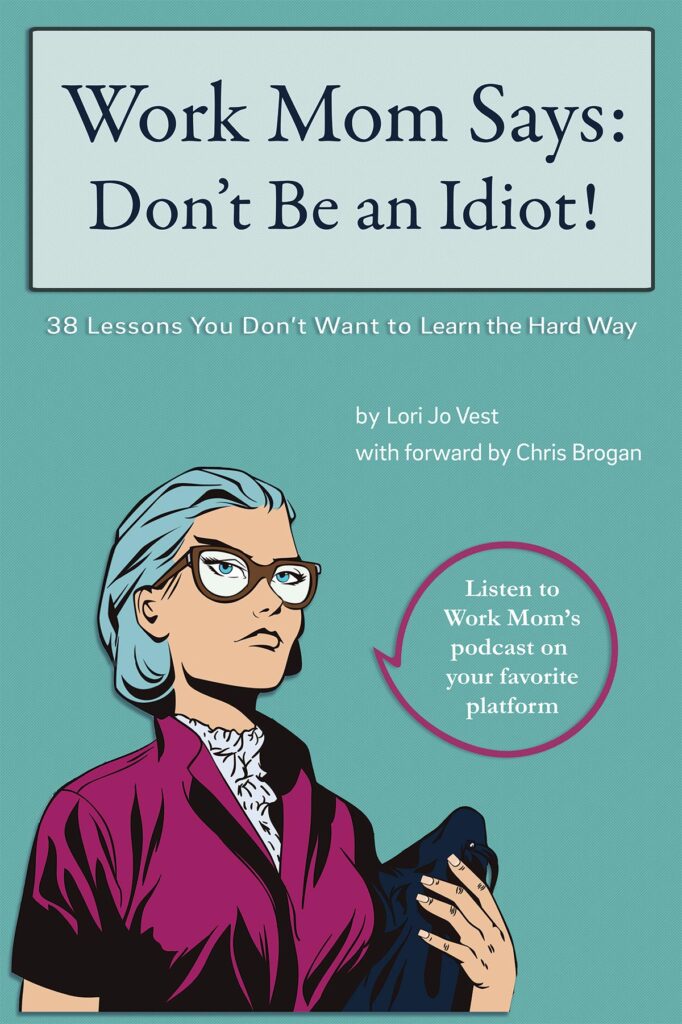
Connect with me on LinkedIn. Order my book!