
#WorkMomSays feedback isn’t an attack — it’s an opportunity to grow, if you know how to handle it. In this episode, Lori Jo Vest breaks down why feedback feels so personal, especially early in your career, and how to shift from defensiveness to strategy.
She explains why being “coachable” is one of the most important traits for career growth, how managers actually view feedback conversations, and what to do in the moment when criticism hits hard.
Through real workplace examples, Lori shares practical ways to pause, respond professionally, and use feedback to your advantage — helping you stand out, grow faster, and stay in the game.
Themes discussed in this episode
- Why feedback feels personal and how to separate your identity from your work
- The importance of being coachable in professional environments
- How managers view feedback as an investment in employees
- Practical strategies for responding to criticism without reacting emotionally
- Handling difficult or unfair feedback from clients and coworkers
Episode Highlights
Time-stamped inflection points from the show
00:07 — Lori introduces the idea that feedback is not an attack, but a necessary part of growth in your career.
02:03 — The difference between school and work: being right vs. being coachable.
04:00 — Why defensiveness, shutting down, or over-apologizing can damage how managers view your potential.
07:21 — A real-world example of receiving frustrating feedback and choosing not to react emotionally.
11:50 — How to handle difficult or unfair client feedback professionally — and when to simply let it go.
Top Quotes
00:34 — “I talk a lot about how feedback is love. It’s not an attack.”
04:00 — “Navigating criticism and negative feedback at the office is a key workplace skill, and it directly determines how managers see your potential.”
04:56 — “So feedback is data. It’s not a verdict.”
11:52 — “Customers can often act really awful and give you feedback that might be completely incorrect.”
Transcript
00:11
Hello, I’m Lori Jo Vest. Thank you so much for joining me for this episode of Work Mom Says Don’t Be an Idiot. Today, we are going to talk about feedback. If you’ve listened to me, you know all the episodes — we’re up to 62 now. That’s a lot of episodes. I talk a lot about how feedback is love. It’s not an attack.
So today, I want to talk about how to take a hit and stay in the game. And I always say that business is an emotional contact sport. It really is. And how you manage your emotions in difficult situations is what will make you successful, or have you just staying at the same rung on the ladder for the next 20 years. You don’t want that. Trust me, you don’t want that.
01:00
So, your manager just told you your presentation missed the mark. Your stomach dropped. Your face scrunched up. And now it’s 2 o’clock in the morning and you are just continually looping that conversation in your head.
Let’s talk about what really happened and what you can do so that those kinds of hits don’t hit you so hard. The moment someone critiques your work and everything in you wants to deflect, defend, or disappear, you don’t have to do any of those things. You need to be strategic. The second you feel that feedback hitting you hard in the gut, pause.
02:03
Because I’m going to give you a whole new way of handling that that will have you actually enjoying feedback and learning from it and having it make you look like one of the best employees on the roster. So here’s the thing. School trains you to be right. They train you how to find the right answer, how to write the right paper. But work needs you to be coachable.
And that means some of the ways you do things may not always fit the culture, the environment, the boss. Your boss may want something different. That happens. In college, your feedback was constant and very clear — grades. Here’s a rubric. You can do exactly what’s on the rubric. You know you’ve got it right.
02:50
At work, you don’t have a rubric. I don’t know that there was a job ever where I had a very consistent and completely 100% applicable job description. In most cases, you have a job description that’s kind of approximate. They throw you in and you figure it out. That is completely normal.
So, when you start that new job and you feel like, oh my God, I have no idea what I’m doing, you’re right. You don’t know what you’re doing. Until you’ve been with a company six weeks, eight weeks, 12 weeks, you don’t really know how it works.
03:32
So, first things first, be gentle with yourself when you start a new gig. Because it can be really difficult when you’re learning something new. You think you’re supposed to have all the information. You’re supposed to know what’s expected of you. And you just don’t. And that’s okay.
The emotional math is when your work is you, criticism of it can feel personal. And what that means is when you start a new job and somebody calls out something they want you to do differently, it can feel like they’re really coming at you.
04:00
And you may want to defend yourself and talk about why you’re doing it right. But defensiveness, shutting down, over-apologizing, all of those things cause you to lose points. Navigating criticism and negative feedback at the office is a key workplace skill, and it directly determines how managers see your potential.
You’ll hear people use the word coachable. And what coachable means is that you can listen to someone’s feedback, consider how you can change or that you should change, and do so.
04:56
If you’re not coachable, you’re standing up like this and saying, no, no, no, I’m not doing it that way. This is why my way is better. At the workplace, it’s not a good idea to be defensive. Being coachable is the totally appropriate response and what most managers expect out of their stellar employees.
And so here’s how you can reframe a negative feedback situation so that you will come out shining no matter what that feedback is. So feedback is data. It’s not a verdict. It could be somebody’s opinion. It could be something they simply just prefer. But if they’re the boss, great. That’s great. You do it their way.
05:39
If a manager is telling you what you’re doing wrong, they’re actually making an investment. As a leader, I have managed, you know, I don’t know, maybe close to 100 people in my lifetime. The people that I don’t feel are going to learn from what I’m telling them, I don’t bother.
The people that I know can grow and that I see moving forward and growing in the company and in their careers are the ones that are coachable, that take the feedback. And they’re the ones that I want to talk to about things they can do to evolve their skillset. If you’re somebody who I don’t see as coachable, I won’t bother. But you’ll also be the first one that gets let go.
06:28
When something happens or sales decline or you lose a client, your boss has decisions to make on the daily about the staff, how much that staff costs them, how much staff is needed to manage the workload. And if you’re the person that doesn’t listen to feedback well and isn’t open to it, and doesn’t have the ability to really consider it, you won’t be on that list of people that the manager is investing their time in. You’ve got to think of it that way.
So when you get feedback that’s hurtful, and I’ve had some feedback that was just nuts — I may have told this story before, but I’ll tell it again because it’s so funny.
I used to write social media copy and I wrote something. It was a post targeted to women in their, in midlife, you know, 40s, 50s. A lot of women carry a little extra weight.
06:50
The quote that was shown on the graphic was your dress size doesn’t matter any more than your shoe size. And as a woman in midlife writing that content, it really resonated with me because nobody ever asks you your shoe size or looks at your shoes and goes, oh my God, your feet are so big. But people do comment and feel bad about their dress size. And so, you know, I’m presenting this deck of copy and I’ve got a room full of, you know, six or eight people. Everybody’s chiming in with their thoughts.
Someone looks at that post and says, well, what about women with big feet? And I wanted to roll my eyes so hard that they fell out of the back of my head, but I didn’t. I just sat quietly and watched what the room did because I had creative directors and people that were above me in the room.
07:43
And I watched what they did because from my perspective, it was a really strong post that would resonate with a lot of women. From this art director’s perspective, I don’t know, maybe she had big feet. It was something that would offend a certain portion of women. From my perspective, that portion of women was going to be very, very small.
I watched the room and what happened was everybody kind of went, well, yeah, I guess that could be seen as being negative. And I literally wanted to, again, roll my eyes out of the back of my head. I didn’t. I thought about it for a minute and I went on to the next post. Great, we’ll change that. We’ll find another new quote.
But I didn’t react. I didn’t say, well, you know, that’s ridiculous. Or, well, I felt that. And my voices in my head were saying that. That’s ridiculous. You know, how many women are worried about their shoe size? I don’t think I’ve ever met one. And that wouldn’t have been the right response.
08:49
So that’s not what I did. I was quiet, listened to everybody, said, oh, well, okay, that’s cool. We’ll find another option. Keep moving forward. That is the best thing to do in those kinds of situations.
Now, if your feedback from your boss is something about how you perform, like I got some feedback once that I sent too many emails, that I needed to have more direct one-on-one conversations with the office instead of sending emails and CCing people. Now, I had thought that I was doing it right, that I was making sure my bases were all covered, you know, making sure that everybody had all the information they need, informing people. He said I was filling up people’s inboxes.
He’s the boss. Like, cool. All right. So now, you know, from that point forward, I would walk over and talk to someone instead of sending them an email.
09:40
But downside of that is if they weren’t at their desk, you got to keep going back over and over again until they’re at their desk. So I made a kind of a deal with myself where if they were at their desk and I could talk to them, I would. If I couldn’t, I’d send a quick email, but I would CC a lot less people. That worked for me and for him.
I didn’t take it personally, even though I really did feel like I was protecting myself by sending emails. He was a more casual guy. I didn’t like it, so I stopped doing it.
So what do you do when someone confronts you about a particular aspect of your behavior in the workplace that they want you to change?
10:16
Pause before you react. Take a breath. Maybe go to lunch. If it’s something that is really bothering you, take a walk. Go get a cup of coffee. Give yourself, you know, 20 minutes at least, if not a few hours to respond.
Ask one clarifying question. This buys you time and also reflects maturity. So if you are in a situation where somebody says, well, I really need you to not send so many emails, I probably should have responded with, you know, well, tell me more about that. Or, well, why do you think there’s too many emails? Or, you know, is that something that you’d like me to change?
And by asking that question, it does buy you more time. It actually allows you to just stop for a minute in that conversation.
11:10
Maybe ask a couple of questions. And if you, even if you don’t feel like it, thank them. Thank you for your feedback. I appreciate it.
And then come back with what you have changed once you do. So, for example, I went a month or two without sending as many emails. The next time I had a one-on-one with that manager, I said, you good? You know, I’m better with emails. He’s like, oh my God, absolutely. Yes. Yes, absolutely.
So, you let them know that you have identified with the issue that they’re bringing up and that you are doing something about it. Get their confirmation that it’s working. That’s always a really good thing. Now, if you’re dealing with a client, this is where it can get difficult.
11:53
Customers can often act really awful and give you feedback that might be completely incorrect. You’re going to do the same thing. You’re going to pause before you react. You’re going to ask a question or two, maybe three, to kind of get them talking. And the more they talk, the more you’ll understand what it is they’re specifically asking.
Thank them, and thank them genuinely, because anytime anybody gives you feedback, it’s love. And then let it go.
I had a client that actually fired us, fired our agency a couple months ago. And they had been really crabby, really combative. Our styles were not meshing. Their expectations were very unrealistic.
12:40
And I got an email that said, you know, we’re disengaging from this relationship immediately. And then it was like six paragraphs long. And I looked at that email and went, you know, I could respond to each of these paragraphs and each of these points that she made because she wasn’t correct in the things that she was saying.
She was reflecting her desire to essentially have us full-time assigned to them as our only client. And we couldn’t do that. We couldn’t give them the time and attention that they wanted because they really wanted a full-time person on their staff. Didn’t work.
13:18
So I knew that no matter how I responded, she wasn’t going to be able to hear it, see it, feel it, agree with it. So why bother?
So I just sent an email that said, understood. Here’s all the materials and links to get them. So if you need anything as we wrap up the relationship, please let us know if we can be of service to you in the future. And what that did was that let me step away from that situation cleanly. I didn’t have to think about it anymore. I didn’t have to worry. I didn’t have to go back and forth. I didn’t have to even read the email if I didn’t want to. And I don’t really think I did.
13:57
I didn’t finish it because it wasn’t a legitimate relationship that I was interested in keeping. And it wasn’t the kind of feedback that was going to change anything for us because we were not going to change our business model based on that one client’s desires.
So we weren’t going to be able to help her. But she was giving us feedback. It was really negative. It felt like a punch in the gut. And I responded very professionally in a way that I could feel good about. And then I let it go.
14:28
And it was the best. I haven’t thought about it in weeks until I just mentioned it. So that’s what I’ve got for you today. Thank you so much for joining me.
If you are watching this on YouTube, please give me a subscribe and a like. We’d love to reach more people with this work because I love sharing how to play the emotional contact sport of business with young professionals. It’s not changing who you are. It’s just changing how you behave and thinking strategically so that you can make strong decisions that help you climb that career ladder and get that position or that dream that you’re really chasing.
So you can also visit my website at workmomsays.com. I have a contact form there. I am also an open networker on LinkedIn, so I’d love to hear from you. If you have an idea for a guest I should have on or a topic you’d like me to cover, please get in touch. Otherwise, I’ll see you in a few weeks with some more helpful information to help you learn how to play the emotional contact sport of business. Thanks so much.
Who is our ideal listener?
This podcast is for young professionals who want to learn to play the emotional context sport of business and experience less drama and more success.
How can you be more logical and less emotional? Be strategic, and Work Mom Says can help you.
“I tell people to back up, put down the magnifying glass, and look at the big picture when you’re responding to something,” said Lori Jo Vest, Work Mom. “In doing this, you will understand that what’s really upsetting you right now will be something you don’t even remember next week.”
What value can people get from listening to this podcast?
Listening to Work Mom Says can help you grow your mood management skills, grow your ability to reframe situations, and look at things from a strategic point of view. This makes it easier to go into a work situation and get the most positive results.
On Work Mom Says, we also offer tips and tricks for creating connected positive relationships that last over time. People will want you on the team if you can create connected positive relationships and work environments. You become an asset, and you will be more successful when you’re an asset.
“I also like to talk about developing traits like optimism, persistence, tenacity, stick-to-itiveness, sticking with things, and approaching every project with a curious mind instead of a fearful mind,” said Lori Jo Vest, Work Mom
Why do I do this? A few more words from Work Mom
I do this because I naturally fell into the Work Mom role when I worked in the ad agency business and had so much fun with it. I also realized I had made just about every mistake there was to make. I don’t hold myself as a stellar example of truth and how you should be. I hold myself out there as someone who has been bruised, battered, and beaten up and learned some important lessons. I’d love to share these lessons with young people, so they don’t have to make those same mistakes or be the idiot I was.
I also want to help young professionals realize that many things our culture prioritizes aren’t really important. We talk a lot about what should be important and how to present your best face at the office so that you can succeed.
I’ve learned so much throughout my career, and it’s gratifying to share that with young professionals and help them avoid some of those mistakes and get to that success sooner.
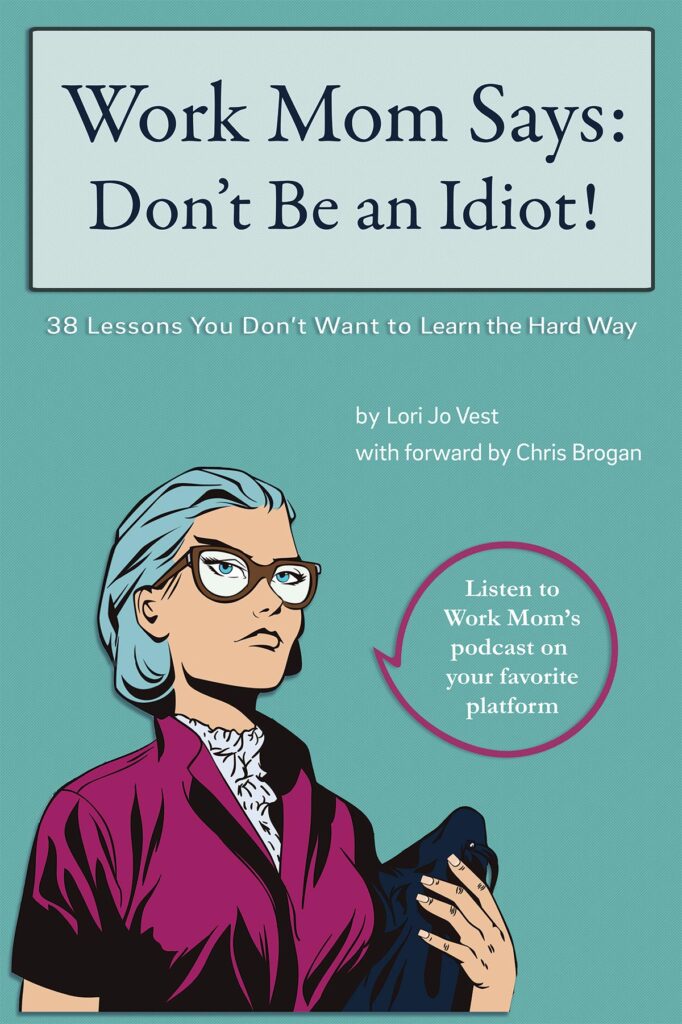
Connect with me on LinkedIn. Order my book!